Decoding Karuizawa Vintage Round Labels: Rare Whisky Value and Professional Buyback Guide

Want to know what this bottle may be worth?
Send photos and we will give an initial estimate based on edition, box and certificate, fill level, and bottle condition.
WhatsApp photo quoteWhy can Karuizawa sell at these prices? Rarity alone does not explain it. As Hong Kong older-whisky buyers, Whisky Era regularly meets collectors seeking to sell valuable holdings. Within Karuizawa's complex range, Vintage single-cask round labels are a foundational category for experienced enthusiasts and investors.
From a professional buyer's perspective, this article decodes Karuizawa Vintage round labels, the market-value references given here, professional authentication standards and the outlook for investment and buyback. If you hold these rare whiskies and are considering a sale, this comprehensive guide will help you understand market movements and compare individual quotations for collectible expressions.
1. Karuizawa's Legend and the Birth of the Round Label
Established in 1955 on Mount Asama's southern slopes in Nagano, Karuizawa initially supplied whisky for parent company Daikoku Budoshu's blends. Christie's distillery history dates the move towards Golden Promise barley and sherry casks to the late 1970s. This barley was also a Macallan speciality. Karuizawa retained traditional small stills and maturation in Spanish sherry casks. Its costly approach and low annual output of around 150,000 litres created its rich, deep style.
Its commitment to quality did not initially bring strong market demand. Karuizawa announced a production stop in 2000; distillation never resumed at the old site, and its buildings had been demolished by 2016. Some equipment moved to other distilleries, leaving it a silent distillery whose original output cannot be recreated. From 2007, independent bottler Number One Drinks, founded by David Croll and Marcin Miller, introduced single casks internationally and purchased the remaining spirit in 2011. Karuizawa's single-cask whiskies then began their remarkable auction story.
Among its ranges, Vintage round labels use simple geometry and direct vintage information to define single-cask identity. The author values them as collecting targets at secondary auctions and in Hong Kong whisky buyback; actual liquidity still requires assessment of cask number, edition and recent transactions.

2. Decoding the Vintage Round Label
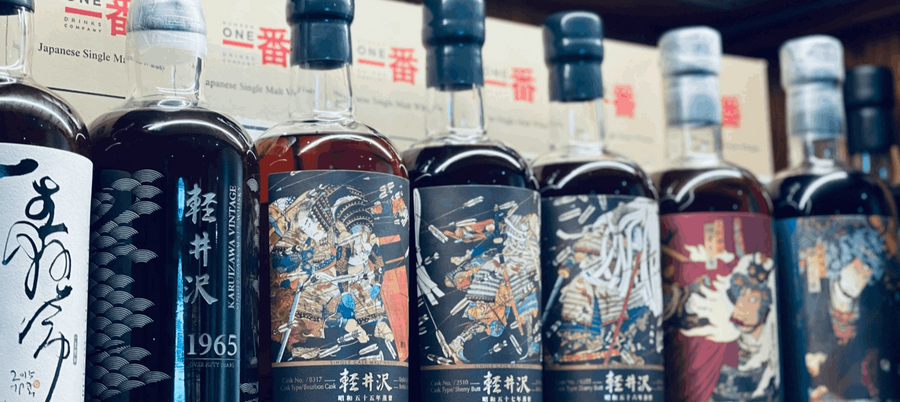
Understanding Karuizawa value begins with reading the label. Compared with the narrative Noh masks and elaborate Geisha designs, round-label aesthetics reflect traditional Japanese packaging and modern minimalism.
For professional buyers, a label is both design and an initial authentication reference. Here are its core features:
Table One: Karuizawa Round-Label Features and Identification Details
| Label component | Professional identification details | Relation to value and authentication |
|---|---|---|
| Washi base | Some premium editions use handmade paper with natural deckled edges and visible fibres. Material and edges require checking for the edition. | Fibre patterns and feel provide clues for edition comparison, but paper alone cannot guarantee factory provenance or authenticity. |
| Circular markings | State the distillation year, for example 1972, and bottling year, for example 2011. | The two years help check time matured in the cask, while actual age still requires checking the dates and stated age. The author values the scarcity of earlier vintages and long maturation. |
| Printing and foil | The original text describes multicolour letterpress, tactile ink relief and foil lines. Actual printing methods require comparison with reliable examples of the same edition. | Key physical authentication details. A single cask number, such as #7038, identifies the source cask. |
| Neck accessories | Some premium releases, including 1960s vintages, have handmade netsuke carved from original cask wood. | Add artistic completeness and a collecting ritual; missing accessories substantially reduce buyback value. |
3. Classic Karuizawa Vintage Round Labels and the Market-Value References in This Article
Karuizawa value combines maturation time, individual cask performance and bottling quantity. After the enthusiasm of 2021–2022 and corrections in 2023–2024, the author considers the market to be building a more rational base. A 2026 auction sold two 1999 casks at a record valuation of £4.25 million, around £2.125 million each, indicating continuing confidence among leading collectors in their scarcity.
For a clearer market picture, we have compiled market and auction references for selected classic Vintage round-label expressions using this article's approximate reference rates of €1 ≈ HK$8.4 and £1 ≈ HK$9.8:

Table Two: Classic Karuizawa Vintage Round-Label Market References, Converted to HKD at This Article's Reference Rates
| Distillation year / cask | Bottling year / quantity | Market and flavour position | International reference, original currency | Estimated HKD value |
|---|---|---|---|---|
| 1960, #5627 | 2013 / 41 bottles | An exceptional 52-year-old with its own netsuke, regarded as a Karuizawa holy grail and auction legend. | £363,000, Sotheby's 2020 result | Approximately HK$3,557,400 |
| 1967, #6426 | 2009 / limited | Early Number One Drinks bottling, a leading sherry-cask example with deep leather and old-wood notes. | €9,337, Fine Spirits Auction reference | Approximately HK$78,430 |
| 1969, #8183 | 2012 / limited | Rare ex-bourbon maturation, showing lighter vanilla and tropical fruit. | €8,069, Fine Spirits Auction reference | Approximately HK$67,780 |
| 1972, #7038 | 2011 / 523 bottles | A 39-year-old at 63.3% ABV. The author considers it a commonly encountered older expression in secondary markets, without providing a trading-volume ranking; a sherry-cask classic. | €8,250, Best of Wines retail quotation | Approximately HK$69,300 |
| 1984, #8173 | 2014 / limited | Bourbon-cask maturation at 58.5% ABV, popular in Europe with more international packaging. | €3,338, Fine Spirits Auction reference | Approximately HK$28,039 |
Note: HKD values are references only. Actual offers depend on condition, fill level, accessories and international market changes on the day.
4. Four Factors in Older Karuizawa Buyback Prices
At Whisky Era, single-cask appraisals consider more than label numbers. Tiny physical changes can create differences of tens of thousands of Hong Kong dollars.

1. Fill Level and Evaporation Whisky may evaporate in the bottle over time, which differs from angels' share during cask maturation. Compare fill with the normal initial level for the same edition, capacity and bottle shape. The original discount references below are retained and are not fixed standards for every whisky.
- Into the neck: The original text uses 100% of market value as a reference; closure, provenance and the physical bottle still require assessment.
- High shoulder: Typically around 25% lower value, suitable for drinking or lower-priced collecting.
- Mid shoulder: Value falls to 60% of the market reference. Further examination of the closure and liquid is needed; liquid level alone cannot prove oxidation or deterioration.
- Low shoulder / high body: Only 20% of value or less, with little collectible appeal.
2. Original Box and Accessories Karuizawa collectors strongly value artistic completeness. The original text uses a possible price difference of up to 30% for a missing original wooden box, or OGB, as a risk reference. Actual valuation requires assessment of the original accessories and specific edition. We also carefully check wood grain and whether the box's label number matches the bottle.
3. Label Condition Foxing, moisture distortion or tears in round-label washi caused by unsuitable storage are linked in the original text to a 10–20% price difference as a risk reference. The actual effect still requires examination of the edition and physical bottle.
4. Closure Integrity Reheating wrinkles in wax or shrink-wrap, a loose closure or leakage can sharply reduce value and may lead to refusal.

5. Storage Science: Protecting a Million-Dollar Liquid Collection
Maintaining the condition of premium older whisky such as Karuizawa requires careful storage. If you are looking after these treasures, follow three principles:
- Upright storage: Unlike wine, whisky's high alcohol content, often 60% or more for Karuizawa, can damage and break down cork during prolonged contact, harming the liquid. Therefore, always store whisky upright.
- Stable temperature and humidity: Ideally keep 15–25°C, with 22°C described here as optimal, and 40–60% relative humidity, ideally 50%. Above 60%, washi may mould or wrinkle; below 40%, cork can shrink and accelerate evaporation.
- Protection from light: UV can damage whisky's molecular structure and fade colour. Keep bottles in their original wooden boxes away from direct sunlight.
6. Karuizawa Collecting and Buyback Outlook for 2026
The secondary market has changed substantially in recent years. The original text cites a 75% rise in Karuizawa's auction index in 2021–2022 and a decline of more than 55% in 2023–2024 as background, without identifying the index source or full calculation periods. The author links these changes to higher interest rates and economic conditions.

By 2025–2026, the author observes signs of stability and selective recovery. Premium holders and professional investors no longer chase prices blindly, instead targeting exceptionally scarce, historically meaningful whiskies such as older Karuizawa round labels distilled before the 1970s. Christie's £4.25 million sale of two 1999 casks in 2026 strengthens the author's interest in their scarce collecting value. Individual auction records cannot guarantee inflation protection across economic cycles or continuing appreciation for every rare whisky.
For round-label owners, the author sees the market adjustment as an opportunity to reassess collections and compare professional offers. Whether to sell still requires assessment of cost, edition and transactions.
Whisky Era—Your Professional Partner for Premium Whisky Sales
Do you hold Karuizawa, Macallan, Yamazaki or other premium older whisky and brandy? As experienced spirits buyers, Whisky Era uses international market channels and rigorous authentication to offer competitive, fair buyback service.
We offer free initial WhatsApp appraisals. Send a front view including the box, label details, sealing film and a clear fill-level photograph. Our specialists will provide a market-based quotation as quickly as possible. The process is confidential, with immediate cash settlement to protect your transaction and interests.
Well-preserved older and limited releases usually need assessment against recent sales, auction records and physical condition.
Related links: Macallan Series Buyback Market, Yamazaki Series Buyback Prices, Hibiki Series Buyback Overview, Karuizawa Buyback Page, Japanese Whisky Buyback Page
Whisky buyback valuation
Have a similar bottle? Get a free initial quote
For one bottle or a larger collection, send photos first and we will reply with market-aware guidance.
- Edition and vintage check
- Same-day initial quote
- Hong Kong pickup or in-store handover
Please show the front label, back label, capsule, fill level, box, certificate, and any visible defects.