More ‘Hardcore’ Than Macallan? Understanding Karuizawa’s Craft and Japanese Whisky Legend through Distillation and Sherry Casks

Want to know what this bottle may be worth?
Send photos and we will give an initial estimate based on edition, box and certificate, fill level, and bottle condition.
WhatsApp photo quoteLearning from the ‘King of Sherry Casks’: Karuizawa's Blueprint
From its founding in the 1950s, Karuizawa chose an individual path, directly following the methods of Scotland's leading Macallan brand. Its pursuit of quality began with materials:
- Precious Ingredients: Karuizawa imported all of its Golden Promise barley from Scotland at considerable expense, using the variety favoured by Macallan at the time. Its small grains and high fermentation efficiency came with a cost about twenty per cent above ordinary barley.
- Premium Casks: Karuizawa insisted on expensive Spanish sherry casks. One could cost US$800–1,000, far above a bourbon cask's approximately US$80, showing its willingness to spend for quality.
Its initial malt whisky supplied the Ocean blend, but its quality soon surpassed the parent company's original wine business in sales and price.

Uncompromising Craft: The Difference between Steam Heating and Direct Firing
Heating is an important part of distillation. GAIAFLOW’s official records state that the old Karuizawa wash still moved to Shizuoka uses indirect steam heating; Shizuoka’s other, newly made Forsyth wash still uses a wood fire. This evidence does not establish the heating arrangements of every Karuizawa still throughout its history.
Direct firing is a traditional method whose manual work and costs matter. Consider a general example of coal-fired distillation: an operator shovels coal approximately every ten minutes to heat a small copper still, illustrating the demands of controlling the fire. This is an example of the method, not a verified record of Karuizawa production.
Different heating methods can influence spirit character, while Karuizawa’s flavours need to be understood through its ingredients, distillation and maturation together:
- Rich Body: Direct firing and steam heating create different thermal conditions, but whether Maillard reactions occur, and where caramel or nut flavours arise, depends on equipment, ingredients and maturation. These flavours do not establish Karuizawa’s specific production method. Peat character comes from peated malt and the spirit selected, rather than direct heat alone; oiliness and weight likewise need to be understood alongside other production factors.
- A ‘More Traditional’ Flavour: connoisseurs believe Karuizawa's old-fashioned methods give it, in some respects, more traditional Scotch character than modern Scottish single malts.
From the start of production in 1957 until it stopped in 2000, Karuizawa’s almost half-century of distilling reflected attention to ingredients and maturation. That history cannot all be classified as coal-fired distillation.
Evidence of Quality: Rare Old, High-Strength Spirit
Commitment to craft produced an ageing stability admired by collectors.
Generally, spirit strength decreases during oak maturation. The source cites around 40%–50% as a reference when considering bottling. Actual timing must also reflect the individual cask, flavour and applicable requirements for the whisky; this range is not a universal threshold at which bottling becomes mandatory. These considerations help explain why exceptionally old whisky is rare and expensive.
Karuizawa's methods, however, are described as allowing strength to fall very slowly:
- Exceptional Strength: Other distilleries’ thirty-year-old whiskies are mostly 40%–45%, while Karuizawa’s spirit often retains 60% ABV or more. This is the author’s comparison of high-strength styles, and cannot establish that other distilleries have no equally strong old whiskies.
- Older Releases: This character is why the author values Karuizawa’s older, high-strength releases. The bottlings discussed here do not represent every period or every whisky it released. Enthusiasts’ confidence in these expressions reflects their ageing potential and flavour stability.
Quality and scarcity—production stopped in 2000, buildings were demolished in 2016, and the remaining 364 casks were bottled by three companies from Taiwan, France and Britain—made it a ‘rare whisky asset’.

Distinctive Pricing Power: Auction Evidence of Value
Karuizawa's story of being underappreciated in life and famous after closure, together with scarcity, made it an auction favourite.
- Late Recognition: Karuizawa 12 Year Old Pure Malt won IWSC Gold in 2001, the year after closure. That late honour strengthened its collecting value as supply could only decline.
- Record Prices: Karuizawa once held the single-bottle Japanese whisky price record. A 1960 vintage, cask #5627, aged fifty-two years, achieved ¥2 million in 2013, twice the previous Yamazaki 50 record. In March 2020, it sold for £363,000, approximately US$483,645, becoming the most valuable Japanese whisky at that time.
Strong market performance brought an average increase of more than tenfold for classic Karuizawa over the decade described here. In 2021, the Japanese whisky index's five-year return was 156%, while Karuizawa's own five-year index also showed strong growth. The source sees this as evidence of its premium-market position.
Conclusion: The Enduring Value of a ‘Ghost Distillery’
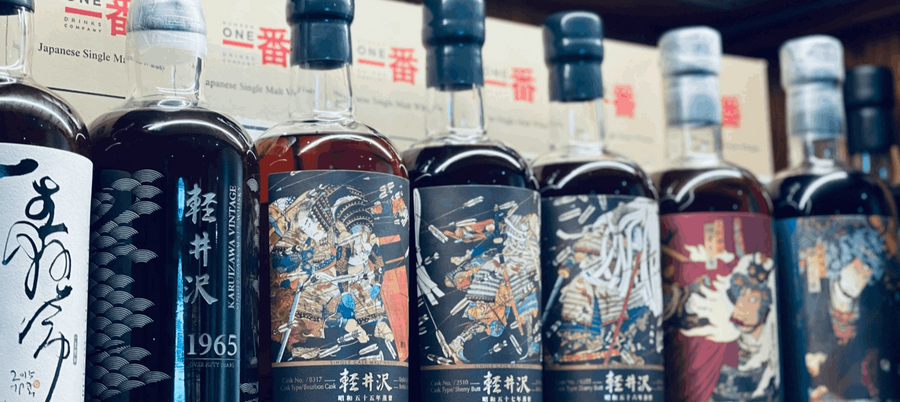
Karuizawa’s success was shaped by ingredients, distillation and premium sherry casks together, rather than coal-fired heating alone. Its uncompromising craft demonstrates the priority given to quality over efficiency and cost. Although the original distillery was demolished and became a ghost distillery, surviving releases carry that lasting value: early Circle Labels, the artistic Geisha series, classical Noh mask labels and Taiwan’s black-and-white Aqua of Life releases aged 30–50 years.
At Whisky Era, we understand these bottles' market and historical significance and offer professional valuations.
Whisky Era Professional Buyback Service
What is your Karuizawa worth? Whether a record-setting 1960 single cask, Aqua of Life set or artistic Thirty-Six Views of Mount Fuji release, we are happy to offer competitive individual cash-purchase quotations based on edition and condition.
For example, Karuizawa 1973 Round Label, cask #1607, had a 2020 auction estimate of HK$87,500–125,000 (this was the auction house's estimate at that time; actual buyback prices depend on the day's market and bottle condition).
What Information Can You Prepare Before a Valuation?
If you plan to sell whisky from your collection, take clear photographs of the front label, back label, closure and packaging to reduce uncertainty during valuation.
Contact Whisky Era to sell your legendary whisky and obtain a buyback valuation.
- Business: Whisky Era
- Contact: WhatsApp: (852) 46135750
- Service commitment: free professional authentication, cash transactions and professional purchases of Karuizawa, Yamazaki, Hibiki and other premium Japanese whiskies and old spirits.
More Market References
- Related reading: Whisky Becomes a Watch: Finance Executive Mr Leung Trades One Premium Collection for Another
- Also read: Karuizawa Holds Its Crown, with Uncommon Releases Still Worth Watching
- Also worth a read: Why Is Karuizawa Whisky So Rare? An Analysis of Hong Kong Buyback Prices
- Current buyback quotation: Karuizawa Samurai 30 Year Old 4 Buyback
- Check buyback prices: Karuizawa 31 Year Old Gold Geisha Buyback
- Other bottles in the same range: Karuizawa Range Purchase Guide
If you plan to sell whisky from your collection, take clear photographs of the front label, back label, closure and packaging to reduce uncertainty during valuation.
Whisky buyback valuation
Have a similar bottle? Get a free initial quote
For one bottle or a larger collection, send photos first and we will reply with market-aware guidance.
- Edition and vintage check
- Same-day initial quote
- Hong Kong pickup or in-store handover
Please show the front label, back label, capsule, fill level, box, certificate, and any visible defects.