A Vanished Distillery's Race Against Time: Why Karuizawa Remains an Auction Favourite in 2026

Want to know what this bottle may be worth?
Send photos and we will give an initial estimate based on edition, box and certificate, fill level, and bottle condition.
WhatsApp photo quoteHello, collectors and investors in premium spirits. I am your professional older-whisky and spirits buyer, “Whisky Era”. As we authenticate and appraise premium spirits for customers every day, one name retains a legendary aura and exceptional prestige: Karuizawa.
Entering 2026, global whisky auctions are undergoing a deep rationalisation and structural adjustment. Yet as funds are reallocated in a flight to quality, Karuizawa Distillery, physically reduced to rubble long ago, retains its commanding auction position. Why can whisky from a vanished distillery reach high valuations in 2026, and how does its performance compare with gold and conventional shares? Whisky Era examines its historical methods, climate, artistic marketing and recent auction references to decode its investment and buyback value.
Chapter One: The Birth and Loss of a Legend—A Limited Supply That Cannot Be Recreated
Karuizawa's position today is inseparable from the distillery's difficult fate. Its discontinued status gives each bottle an almost martyr-like appeal.
1. Exceptional Craft Beneath an Active Volcano
Karuizawa Distillery was built in 1955 at the foot of scenic Mount Asama, an active volcano. While Japan's mid-century whisky industry was still exploring and imitating, Karuizawa chose a costly, low-output path of traditional Scottish methods. It began importing barley from Britain in 1958 and later insisted on 100% premium Golden Promise barley. Although yields were low, the barley gave the spirit rich oiliness and a dense structure, helping it retain a powerful body after decades of maturation.

The distillery also used small stills of only 4,000 litres and traditional wooden washbacks, and was known for its sherry-cask maturation style. Specific casks require checking for the bottling; not every period and release can be described as using 100% Spanish sherry casks. This apparently inefficient arrangement in an industrial age produced a deep, rich, full-bodied style with dark chocolate and spice.
2. Reverse Angels' Share
Climate was another part of Karuizawa's magic. At 850 metres above sea level, it was then Japan's highest distillery. Summer humidity averaged 80%, while average temperature was only around 10°C. The article uses reverse angels' share to describe some high-strength spirit, but cool, humid conditions alone cannot establish that water evaporates faster than alcohol. Temperature, humidity, cask position and initial strength all affect changes; information about the particular cask is needed. The original author especially values some Karuizawa spirits still around 60% ABV after 30 or even 40 years. Check the label and specific cask for actual strength; the author celebrates these concentrated ‘flavour bombs’.
3. The Turning Point from Decline to Myth
Unfortunately, its heavy sherry and robust body did not suit the Japanese public's preference for lighter flavours in the 1990s. Poor sales led to production being suspended on 31 December 2000. The distilling licence was cancelled in 2011, and the buildings were demolished in 2016, with the equipment auctioned.
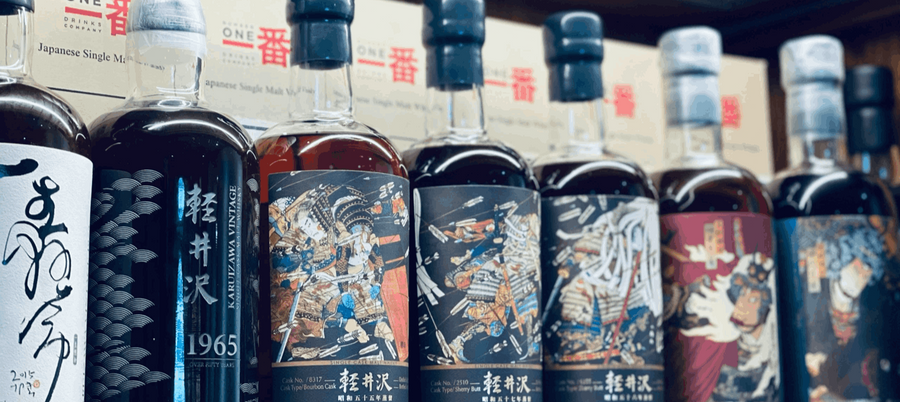
Between 2006 and 2011, however, European pioneers Marcin Miller and David Croll of Number One Drinks recognised its potential and acquired the final 364 casks. Cask-strength single-cask bottlings and labels rich in Eastern art made Karuizawa a success in premium European and Asian markets, beginning its remarkable auction story.

Chapter Two: Art and Scarcity—Understanding Karuizawa's Classic Series
In premium Japanese whisky buyback, Karuizawa's value lies not only in the liquid but also in its artistic labels. This approach attracted funds from both art owners and whisky investors.
1. Geisha Series
The Geisha Series comprises Karuizawa's most recognisable and sought-after treasures. It combines older whisky with geisha imagery from traditional ukiyo-e, symbolising beauty, tradition and a history fading like the distillery itself.
- Sapphire Geishas: This pair of 31- and 36-year-old sherry-cask whiskies has deep-blue labels with dragon details. The two bottles can be placed together like a puzzle to reveal a complete geisha face. This need for completeness substantially raises the premium.
- Ruby Geishas: A milestone in the series is the 34-year-old, cask #3668, limited to 247 bottles worldwide. Its label incorporates cranes symbolising longevity and a deep red associated with nobility.

2. 36 Views of Mount Fuji
Using the famous works of nineteenth-century ukiyo-e master Katsushika Hokusai, this series comprises 36 bottles released in limited batches. Assembling it is so difficult that owning a complete set in 2026 is regarded as a collector's highest honour.

3. 2025/2026 Charity Special Editions
Recently, Marcin Miller worked with British contemporary artist Harland Miller to create hand-painted labels for 10 Karuizawa bottles donated from Marcin's private cask #2347 for charity sales. These are rare limited bottles for that charity project as well as contemporary artworks, giving this Karuizawa artistic collaboration a distinctive conclusion.
Chapter Three: Recent Whisky Auctions and Buyback Value
As a Hong Kong whisky buyer, Whisky Era closely follows global auction figures. To illustrate Karuizawa's market value, we have approximately converted important recent results and estimates to HKD using this article's 2026 reference rates: £1 ≈ HK$9.9, US$1 ≈ HK$7.8 and €1 ≈ HK$8.5.
A Historic Moment at Christie's in March 2026
On 10 March 2026, Christie's London held an auction called A Final Chapter, offering renowned collector Sukhinder Singh's final two Karuizawa casks, distilled in 1999, numbered #6195 and #888. The pair ultimately sold for an extraordinary £4.25 million, approximately HK$42.075 million , an important result in this Karuizawa spirit auction. That implies around HK$21.0375 million per cask. It sends a strong signal that major buyers remain deeply enthusiastic about owning the final chapter of Karuizawa's history.

Reference Market Values for Selected Karuizawa Releases in 2026, HKD
| Release and age | Features and edition | Estimated market value / historical auction price (HKD) | Value assessment and notes |
|---|---|---|---|
| Karuizawa 1960 Zodiac Rat, 52 years | Only 41 bottles worldwide; washi label | Approximately HK$3,590,000 | Reached an auction record of £363,000 in 2020; among Japanese whisky's highest-priced bottles. |
| Karuizawa 1964, 48 years | Cask #3603; bottled in 2012 | Approximately HK$1,020,000 | Reached €120,000 in late 2023; a classic older whisky with a heavy sherry character. |
| Sapphire Geishas, 31 & 36 years | Sapphire Geishas pair | Approximately HK$1,700,000 | The two-label puzzle design gives the complete pair far greater buyback value than individual bottles, approximately €200,000. |
| Ruby Geisha 34 | Ruby Geisha; cask #3668 | Approximately HK$197,800 | Extremely rare at retail, around US$25,365, and highly sought after. |
| 36 Views of Mount Fuji, complete 36-bottle set | Complete ukiyo-e art series | Approximately HK$1,458,600 | Very few complete sets survive; estimated around US$187,000, with a strong investment defence. |
| 36 Views of Mount Fuji, entry-level single bottle | For example, the 36th release | Approximately HK$10,000–15,000 | Single-bottle auctions remain at US$1,300–1,800 or more, with excellent liquidity. |
Note: These prices are conversions of international auction and secondary-market figures. Actual buyback prices require Whisky Era's assessment of fill level, condition and complete accessories.
Chapter Four: Why Is 2026 a Good Time to Sell Karuizawa?
If your cabinet holds Karuizawa, you may wonder whether now is a good time to sell. As experienced buyers, we believe 2026 offers an attractive window for these reasons:
1. Irreversible Physical Risks: Loss of Liquid Whisky is a spirit, but cork ageing is irreversible. A failed seal and falling fill level can cause a sharp loss in value. Seeking an appraisal while your Karuizawa retains an excellent high fill is a sensible way to secure its value.
2. A More Dispersed Market and Generation Z Buyers Using 2026 figures without a stated sample or statistical date as market references, the original author considers that global auctions are undergoing geographical rebalancing, with unprecedented European and American interest in Japanese whisky; the Americas account for 32–39%. Generation Z collectors also comprise 18% of new auction users. They particularly value Karuizawa's story as a vanished volcanic distillery and its social appeal. The author considers that demand across markets helps valuation, while actual buyback still depends on edition, condition and individual quotations; it cannot guarantee the highest price across the whole market.
3. A New Distillery and the Value Divide Around the Original Although the new Karuizawa distillery began distilling in 2022, serious collectors see an unbridgeable value gap between whisky produced at the original site in 1955–2000 and new production. The original author uses premiums above 300% to describe the collecting appeal of historically finite original spirit, but gives neither a comparison basis nor transaction samples. This cannot be applied to every original-distillery release.
In Closing: Let Whisky Era Protect Your Collectible Whisky
Karuizawa is more than a good bottle. It is a final expression of Japanese whisky craft in a particular time and place, turning the passage of time into exceptional premiums. Managing this valuable liquid asset, however, needs professional expertise and accessible international trading channels.
Do you have rare Japanese whiskies such as Karuizawa, Yamazaki or Hibiki, and want to know their value in 2026?
“Whisky Era” (Whisky Era) is your trusted professional partner for older whisky and spirits buyback. We promise:
- Professional authentication: Free online and on-site appraisals, identifying editions and condition accurately.
- Exceptional prices: Following 2026 international auctions and secondary-market figures to provide transparent, fair individual cash quotations based on physical bottles and market references.
- Safe, confidential transactions: Complete privacy, with cash or immediate bank transfer for peace of mind.
If you have good whisky you no longer need, contact us anytime on WhatsApp at (852) 46135750 for an initial appraisal and collection throughout Hong Kong.
Related links: Yamazaki Series Buyback Prices, Hibiki Series Buyback Overview, Karuizawa Buyback Page, Japanese Whisky Buyback Page
Whisky buyback valuation
Have a similar bottle? Get a free initial quote
For one bottle or a larger collection, send photos first and we will reply with market-aware guidance.
- Edition and vintage check
- Same-day initial quote
- Hong Kong pickup or in-store handover
Please show the front label, back label, capsule, fill level, box, certificate, and any visible defects.